
Malaise
The challenge of our time

Malaise
We’re going through another of those times. It’s quite evident. But why does it seem that so many of us do not see it or know that we’ve done it before and that has never been good? Yet we do it again, again, and again.
Crazy, eh?
For the most part, humans aren’t crazy. Almost anyone driving a car swerves to avoid accidents. When calamity threatens, we quickly assess, brake, swerve, even plow into something less dangerous — whatever it takes.
But when it comes to communities of people, things can go very, very bad.
And only a few of us who’ve ever been swept up will wake up to realize that what seemed right once seems so no longer, and suddenly we know we’re not in control of this vehicle at all, that we were never steering the wheel like we imagined we were, that something quite different has happened, and our vehicle is out of control. As if waking from a dream, we realize that we were but spokes in a terrible beast of an engine, a big, collective human engine, an impersonal movement built to overwhelm us. And when it goes awry, what’s to stop it? You? Me? And while we’re reeling from the realization of what we’ve become swept up into, it’s too late because the great impersonal engine has its own speed now, and we can do little more than go along with the others, because we cannot stop it. And what will become of us then?
I write of a collective warp, a malaise, when many of us, for a time, become bent by the dark, angry potential within us, individually and collectively, that sees others as the sole problem, a threat, or worse, as evil.
I’m 81 as I write this. A lifetime of experience. I have seen what I’ve seen.
And now, I recognize the awful arrival of another moment in time when blindness becomes master of the eye, and it sees something evil in them. It is always them who become evil in moments like these. Never us. Remember the witch trials, most famously in Salem, Massachusetts, in the 1600s? It’s well documented. It all began when young girls in a village started having strange fits, and it was immediately believed that their madness had been induced by someone (mostly women) who had bewitched them. The “witches” were rounded up and tried, using “spectral” evidence — i.e., a mere assertion: Yes, that one there — her — used satanic powers to cast a spell over me. Hysteria arose within that tightly religious community, with frenzied accusations and burnings at the stake.
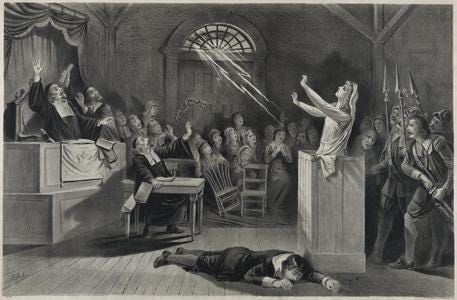
But who had become bewitched? And who was sane?
We understand it now … or so we think
Today, we understand the Salem period as the madness of the few projected upon the other, a mental illness that spread not only through the young accusers themselves, then generalized into a lethal hysteria with its own imperative, exploitable by an alert few who saw opportunity in madness. Yes, there’s opportunity in madness. We learned about it in school.
“But this kind of thing doesn’t happen today,” we might say.
Oh yeah? Behold, the vastly unappreciated power of the unconscious within us: Do you remember the Second Red Scare in the 1940s and ‘50s in the US? I do, that era when we practiced huddling against our elementary school walls in case, “we hope it will never happen, children,” the Communists launch nuclear bombs against us. And so, another kind of witch hunt began, the zeitgeist of America animated by a growing paranoia of “the Commie threat.” The neighbors behind us built a bomb shelter. I was asked to join the John Burch Society. (I didn’t.) And Senator Joseph McCarthy and a few others exploited the paranoia to launch a clamorous campaign against alleged communists in the US government and other institutions. It resulted in blacklists, costing talented people their jobs, while most of the accused did not in fact belong to the Communist Party or, if they once had, were no longer active. But the allegations were relentless, with Communists allegedly in everyone’s closet.
Yet this scare was stopped. During a televised hearing, one man, Joseph Welch, defending a young attorney accused of having ties to a Communist organization, stood against McCarthy. He said, “Until this moment, Senator, I think I never really gauged your cruelty or your recklessness.” McCarthy disregarded him and tried to continue. But Welch interrupted. “Let us not assassinate this lad further, senator. You have done enough. Have you no sense of decency?” In that moment, the entire momentum of the anti-communist fervor in America began to ebb. It’s well documented.

I remember my Dad’s vehement public lectures against Communism. In college, I read about socialism and wrote to my older brother to say it didn’t seem so bad, though I didn’t go along with most of it. Dad headed the government security force for the National Reactor Testing Station in the desert of Southeastern Idaho. He was up for promotion. Fearing reprisals against Dad if they discovered my choice of reading, my older brother Larry, an Army MP captain, reported me to the FBI. Agents arrived at my fraternity house looking for dirt. There was none to find.
How did this kind of madness happen to us less than a century ago, turning brother against brother?
And have you read about these periods of madness: the First Red Scare (1917-1921), the Jim Crow Era, the Holocaust (yes, it really happened!), surges of ethnic violence in the post World War II era, Stalin’s Great Purge, the Chinese persecution of the Uyghurs, etc? They’re all well documented. How do these happen?
But moments of insanity are defeated. Sort of. Or buried until they seep out again when least expected. Good people don’t want to think too much about this stuff, really. But there’s the problem: darkness requires thinking and looking honestly in the mirror.
The horror show
These disturbing periods in human history differ in scale, causes, perpetrators, and victims. We’re not as evolved as we like to think. We crawl too frequently on the edge of madness. And while our technology and science have matured, we have not. And now we are going to pay the price. Again.
Most of us have a healthy instinctive fear of ourselves, our latent tendencies, and we strive to deal with them. We get therapy, talk to someone, seek a support group, or do something — because we know something’s off. Most of us wake up when we find ourselves out on a ledge and don’t know how we got here.
But far too many of us are not aware. This unawareness and the fear of our species’ out-of-control potential are depicted metaphorically in dystopian visions — e.g., zombie movies and all-too-real visions of repressive societies, such as The Handmaid’s Tale and 1984. When entire segments of society rise to demonize another, things get out of control.

We’re beginning to see the horror show in real time.
The malaise, a recurrence
There is a most troubling rise of a religious mania in America. It seeks to ban books, close libraries, fire librarians who dissent, remove great works of literature from the shelves, coerce teachers to teach only a certain point of view, a certain history — don’t talk about the indigenous, the slaves, that’s all overblown anyway, there aren’t a lot of American Indians anymore because they stood in our way and we conquered them, to the victor go the spoils, what’s wrong with that, and speaking of history, a lot that you read about never actually happened, like the Holocaust, it was all a fabrication because they didn’t like Hitler who got a bad rap even though he built Germany from nothing after World War One into a superpower, it’s just like the Woke to fill you with lies, you’ve got to watch out for the lies told in universities, cut their funding, cut the research, we don’t believe in science either, we’ll tell you what true science is ….
And one by one, the concentration camps spring up again. And the lawless rule.
Malaise: Uneasiness of mind or spirit; the unhealthy state of an institution, organization, activity, or situation (Oxford English Dictionary).
It’s this kind of spectral irrationality and hysteria, arising like a ghost in the night, animated by a few, and fomented by those eager to manipulate us — not for us but for themselves, like it’s always been.
Denying the presence of the malaise won’t make it go away. Nor will hoping it will pass. Nor ignoring it. The malaise isn’t coming: it’s arrived, and it will be here until it’s defeated.
The malaise arises from fixed, often deep, beliefs and primitive, irrational fears that overwhelm the possibility for relatedness. These fears live in each of us. Fortunately, many of us have some awareness of them in ourselves. It announces its presence as an at-first inner voice in us that proclaims of another person, “I know what you are, and I condemn you for it. I’m in charge now. I will tell you how to live. Your time is done. It is my time now.”
Our development as a species under the rule of opposites has stunted our growth, while our technology has developed exponentially. How does living totally under the rule of the opposites square with our ability to wipe out entire nations? How does our power to spread falsehood square with our ability to deal with the unexamined powers of our collective unconscious? How do these impact our ability to achieve relatedness on a small planet grown so small?
A world based solely on the law of opposites is no longer sustainable. And given the outsized growth in our technologies, we are forced to look at each other and to think in new ways.
A different response
Something different is asked of us now. To me, it begins with seeing ourselves clearly. While we humans find self-examination difficult, it is a skill most of us can acquire. It evolves in us personally, first as an aspiration, then a lifelong pursuit.
But how does this help to overcome the malaise?
1. By learning to oppose without demonizing, we avoid perpetuating the problem. Demonizing those in thrall of the malaise simply drives its energy underground, where it awaits its moment to resurface. We must bring a different voice into the world, something like this: “We are different, you and I, but we have much in common, too. I’d like us to listen to each other without offence, understand our differences, know our commonalities, and see how we can work together and thrive.”
My brother Larry and I, so different, reconciled. He apologized for siccing the FBI on me. We laughed about it and learned to understand each other because we cared. I stopped seeing him as “the fuzz” and saw a man who cared enough to see beyond how I looked. But merely understanding the malaise is not enough.
2. We must face and conquer our complicit role in demonizing those we despise. Only with greater self-awareness might we effectively oppose the malaise, through the love of truth, learning, self-awareness, and compassion that truth allows.
When my brother, who hated the hippies, saw that I’d become one, his love for me forced him to see himself, me, and perhaps the rest of us, a little differently. Our regard for each other created our willingness to look at our prejudice.

3. Ignorance is only ever defeated in practical, actionable, win-win ways, both great and small.
Larry and I learned to talk with each other from then on. We aired the uncomfortable questions and beliefs. He is gone now.
I remain. With three ever-immediate tasks: to see reality as clearly as I can, oppose the madness in myself, and stand for something new in the world.
Bless you, brother.
Yes, I agree. I have heard it said that 20% of people are suppressive, but 2 and1/2% are truly dangerous.
The "collective unconscious" concept sums up this thoughtful essay for me. A brilliant mind once said basically, (that man's confront of evil is the lowest common denominator among man).